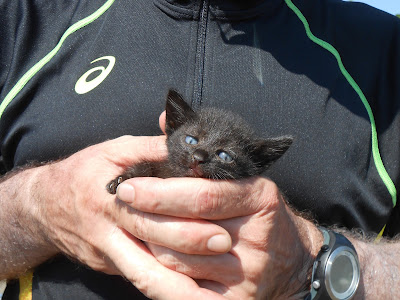
The bear is not the first wild animal which I saw in Japan during a bicycle ride. This one below I found in the north of the lake of Kasumigaura (Ibaraki). It was sitting aside of its dead mother (car accident) in the middle of a road. The temperature at that day was in the middle of the thirties. And the vultures of Japan (crows) were already nearby. So, I took it with me. But as I was still 80kms away from home, it was at risk and I looked for (and found) a new home for it - a farm with many, many cats, the owners ready of accepting another member. A cute little devil.
Japanese often call a small cat: chibi. The meaning of chibi is 禿び, a "small, cute version of a manga, anime character, typically with oversized head". It is something, Japanese consider as かわいい. I am no fan of manga and anime, so I changed the characters from 禿び to 小美 and gave the latter the "not entirely correct" reading chibi. 小(ち) 美 ( び) 小美 is her name now: Chibi, the little beauty. 小美 新しい読み方: 小(ち) 美 ( び) Ein sogenannter Dachhase. On the lookout for "Ubereats Cat"(=me). Gemini says: The term "Dachhase" is a German word that literally translates to "roof hare." However, it's not actually a type of hare. Here's a breakdown of its meaning: Figurative Meaning: 1) It's a humorous or colloquial term for a house cat. 2) Historically, it also referred to cat meat, particularly during times of food scarcity. This connection arose because a prepared cat could resemble a hare, and cats are known to climb onto roofs...
It doesn't show but I am already 19. Don't you think that I am looking much younger? Another 7 years and I will make it in the list of longest-living cats on Wikipedia, another 19 and I will be at the top. Knock on wood. From the time, Felix was younger - just a little bit, he was already 14 or 15.




Comments
Post a Comment